
Nomisma (Greek: νόμισμα) was the ancient Greek word for “money” and is derived from nomos (νόμος) “anything assigned, a usage, custom, law, ordinance”… it is also used by numismatists when referring to the pieces of money or coin.
Nomisma (Greek: νόμισμα) was the ancient Greek word for “money” and is derived from nomos (νόμος) “anything assigned, a usage, custom, law, ordinance”… it is also used by numismatists when referring to the pieces of money or coin.
Source: Wikipedia

WHITE PAPER
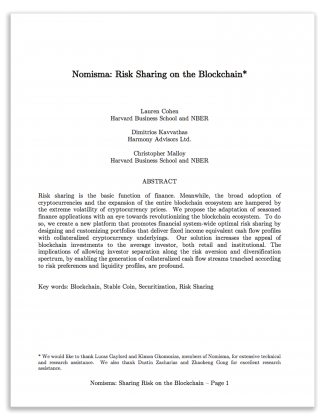
Risk sharing is the basic function of finance. Meanwhile, the broader adoption of cryptocurrencies and the expansion of the entire blockchain ecosystem are hampered by the extreme volatility of cryptocurrency prices. We propose the adaptation of seasoned finance applications with an eye towards revolutionizing the blockchain ecosystem.
To do so, we propose the creation of a new platform that promotes financial system-wide optimal risk sharing by designing and customizing portfolios that deliver fixed income equivalent cash flow profiles with collateralized cryptocurrency underlyings. Our solution may increase the appeal of involvement in cryptocurrencies to the average user, both retail and institutional. The implications of allowing investor separation along the risk aversion and diversification spectrum, by enabling the generation of collateralized cash flow streams tranched according to risk preferences and liquidity profiles, are profound.

NOMISMA TEAM

Professor Lauren H. Cohen
L.E. Simmons Professor of Business Administration
Lauren Cohen is the L.E. Simmons Professor in the Finance & Entrepreneurial Management Unisat Harvard Business School and a Research Associate at the National Bureau of EconomicResearch. He is an Editor of the Review of Financial Studies, along with being a past Editor of Management Science, and serving on the editorial board of the Review of Asset Pricing Studies. Heteaches in the MBA Program, Executive Education Program, Doctoral Program, and Special Custom Programs at the Harvard Business School.
His award-winning research has been published in the top journals in Finance and Economics. It isalso frequently profiled in various media outlets including The Wall Street Journal, The New YorkTimes, The Washington Post, The Economist, and Forbes. It has been recognized by numerousNational Science Foundation (NSF) Awards, including a National Science Foundation EarlyCareer Development (CAREER) Award for his research agenda on Relationships in Finance. Hewas named a 2008 Pensions & Investments “Cutting Edge Academic,” a Top 40 Under 40Business School Professor in 2017 by Poets & Quants, and a top teacher at Harvard by CNBC.
In addition to his academic work, Dr. Cohen frequently advises government organizations in the US and abroad, as well as consulting with top hedge funds in the industry, and serving as an expertwitness in numerous investment- and insurance-related litigation cases. He has testified beforethe United States Congress on the impacts of government spending on the private sector, and hasbeen awarded the Jack Treynor Prize for superior work in the field of investment management andfinancial markets.
Dr. Cohen received a PhD in finance and an MBA from the University of Chicago in 2005. He earneddual undergraduate degrees from the University of Pennsylvania – a BSE from the WhartonSchool and a BA in economics from the College of Arts & Sciences in 2001. He also served on theadvisory board of Cake Financial (acquired by E*Trade) and Quadriserv, Inc. (acquired byEquiLend Holdings – an industry consortium comprised of Goldman Sachs, Morgan Stanley,Credit Suisse, Bank of America, UBS, JPMorgan, Northern Trust, Blackrock and State Street).
Dr. Cohen currently resides in Belmont, MA with his wife – Dr. Nicole Cohen – and their five children.
Lucas Gaylord is a Global Business and Computer Science double major at Hong Kong University of Science and Technology (HKUST). After 4 rigorous years, during which he’s taken PhD, MBA, and MSc classes in addition to creating his own, he will be the first student of HKUST to successfully achieve the dual degree outlined above.
Lucas is an entrepreneur and a technologist. He has worked with and co-founded a variety of Hong Kong based technology startups and social enterprises, hiring and leading teams working both on full-stack development and business administration. Lucas is primarily concerned with Ethereum, high-dimensional statistics, and deep learning; he has conducted research and developed new software in all three domains. He is also an active member of the Ethereum and Elixir communities in Hong Kong and Singapore.
During his studies, he was hired to help create an MSc-level course in Applied Multivariate Statistical Analysis (ISOM 5535 at HKUST). He was responsible for creating lecture slides and implemented the following models in R: PCA, Factor Analysis, Canonical Correlation Analysis, LDA, Gaussian and Ising Graphic modes, multiple hypothesis testing, and Imputation via rank minimization.
A polyglot, and an avid traveler. He has lived on 4 continents and speaks English, German, and Arabic (plus a moderate amount of Chinese from a summer at Peking University). His studies and extracurricular activities have been fully funded by several prestigious scholarships.
Kimon started his career at Goldman Sachs in 2003 before moving to ECM, a boutique fixed income asset manager, in 2004 to work on the development of structured fixed income funds. Kimon joined the Standard & Poor’s Structured Finance group in 2005 as a Senior Quantitative Analyst where he led the development of the rating methodology and monitoring process for the hybrid synthetic CDO business that involves the securitization and risk sharing of cross-asset (Equity, Credit, Commodity, FX and Rates) derivative exposures.
At 2008 he started working at Barclays Wealth & Investment Management in 2008 within the Quantitative Analytics team. Until 2009, he worked on the development of quantitative investment strategies and portable alpha solutions for UHNW private clients and by 2011 he was leading the Quantitative Analytics team responsible for the model development of the Barclays strategic asset allocation for the Wealth business. In 2012, he moved into the Key Clients & Family Offices team to lead a Portfolio Solutions & Consulting function that provides cross asset customized investment solutions and portfolio construction of liquid and illiquid assets to UHNW and Family Office clients with a focus on asset liability management, risk-based and factor investing, alternative risk premia and yield enhancing overlay (portable alpha) solutions.
Prior to joining Financial Markets, he spent 2 years as an Officer in the Hellenic Army, Special Forces Division, Paratroopers Unit and 2 years at Ideal Telecom, a startup company in Greece, as a Database Administrator.
Kimon holds an MPhys in Physics from Sussex University graduating within the top 5% of his class and an MSc in Financial Engineering from ISMA Centre, Henley Business School in the UK.
Dimitrios serves as the Chief Investment Officer of Harmony Advisors Limited, an SFC Type 1, 2, 4 and 9 licensed multi-family office/asset manager. He joined in June 2016, responsible for Harmony’s discretionary investment mandates, which include an in-house multi-strategy hedge fund, managed accounts, private equity and alternatives. Furthermore, Dimitrios oversees the firm’s global asset allocation framework as well as fundamental and quantitative research efforts across all products.
Dimitrios joined Goldman Sachs in London in 2001 and moved to Hong Kong in 2009. He was promoted to Managing Director in 2005 and was invited to join the partnership in 2008. He retired in 2013, having served as co-Head of Asia Pacific Securities Division Distribution (FICC, Equities, Corporate Origination Sales & Structuring), as well as having served on the Asia Pacific Securities Division Operating Committee, the Asia Pacific Risk Committee, the Global Firm-wide New Activity and Asset & Liability Committees as well as the Goldman Sachs (Asia) L.L.C. Board of Directors.
Dimitrios joined VTB Capital in 2013 where he served as Head of Global Markets – Asia Pacific. In June 2014, he joined Noble Group as co-Head of Financial Services. From July 2015, he also managed the Noble Group’s technology business as well as the strat & quant teams Dimitrios earned his B. Sc. in Economics graduating in 1995 as valedictorian from the Department of Economics at the Athens University of Economics and Business. He was awarded his PhD in Economics at the Department of Economics at the University of Chicago in 2001, where he also earned his MA in Economics in 1997. During his time at the University of Chicago, Dimitrios worked as a lecturer at the School of Social Sciences and as a teaching and research assistant at the Graduate School of Business. Between 2013 and 2015, Dimitrios served as Adjunct Professor at the School of Economics & Finance at the University of Hong Kong.
Professor Christopher J. Malloy
Sylvan C. Coleman Chaired Professor of Financial Management
Christopher Malloy is the Sylvan C. Coleman Chaired Professor in the Finance Unit at Harvard Business School, and a Faculty Research Fellow at the National Bureau of Economic Research. Prior to joining HBS in 2007, Professor Malloy was an Assistant Professor in the Finance Department at London Business School, where he-hb was on faculty from 2003 2007. Professor Malloy currently teaches the second semester investment strategies and stock pitching courses at HBS, and has previously taught courses in behavioral finance, corporate finance, and equity investment management.
His research focuses on behavioral finance, asset pricing, investments and portfolio choice, labor economics, and empirical corporate finance. His research has appeared in the Journal of Political Economy, the Journal of Finance, the Journal of Financial Economics, and the Review of Financial Studies, and has been described in The Financial Times, The Wall Street Journal, The New York Times, and various other media outlets.
Professor Malloy received a PhD in Finance and an MBA from The University of Chicago Graduate School of Business, and a BA in Economics from Yale University. Before beginning his doctoral studies, he-hb worked at the Board of Governors of the Federal Reserve System in Washington, DC in the Monetary and Financial Studies Section.
Daniel Mamadou is a specialist in investment banking and capital markets. During a career of more than 25 years spent in Europe and Asia, he has held leadership positions at Deutsche Bank, Goldman Sachs, Nomura and Bank of Tokyo-Mistubishi, where he focused on fixed income derivatives and structured credit. Daniel currently co-manages the trading department of rare earths elements and technology metals at Noble Group. He also sits on the board of Talaxis, a private company that has developed a global supply chain in critical technology metals such as cobalt, lithium and neodymium.
Mr. Barna Semsey is a financial professional and entrepreneur with a broad range of expertise across developed and emerging markets, financial technology, banking, investment management, corporate strategy and real estate. Mr. Semsey is working independently, primarily advising financial institutions.
Previously Mr. Semsey worked in the fund structuring team at Goldman Sachs Securities in Singapore. Prior to Goldman Sachs he worked at Barclays Capital where he started at Strategy and Planning and subsequently joined the Funds and Advisory team in London. He moved to Singapore with Barclays to set up the business in Asia including a newly licensed fund management company in Japan.
Mr Semsey received a Diploma in Economics from Budapest University of Economics Sciences and an MBA from IESE, Barcelona. He has also holds a Masters in Public Administration from SUNY Albany, New York.
NOMISMA TEAM

Professor Lauren H. Cohen
L.E. Simmons Professor of Business Administration
Lauren Cohen is the L.E. Simmons Professor in the Finance & Entrepreneurial Management Unisat Harvard Business School and a Research Associate at the National Bureau of EconomicResearch. He is an Editor of the Review of Financial Studies, along with being a past Editor of Management Science, and serving on the editorial board of the Review of Asset Pricing Studies. Heteaches in the MBA Program, Executive Education Program, Doctoral Program, and Special Custom Programs at the Harvard Business School.
His award-winning research has been published in the top journals in Finance and Economics. It isalso frequently profiled in various media outlets including The Wall Street Journal, The New YorkTimes, The Washington Post, The Economist, and Forbes. It has been recognized by numerousNational Science Foundation (NSF) Awards, including a National Science Foundation EarlyCareer Development (CAREER) Award for his research agenda on Relationships in Finance. Hewas named a 2008 Pensions & Investments “Cutting Edge Academic,” a Top 40 Under 40Business School Professor in 2017 by Poets & Quants, and a top teacher at Harvard by CNBC.
In addition to his academic work, Dr. Cohen frequently advises government organizations in the US and abroad, as well as consulting with top hedge funds in the industry, and serving as an expertwitness in numerous investment- and insurance-related litigation cases. He has testified beforethe United States Congress on the impacts of government spending on the private sector, and hasbeen awarded the Jack Treynor Prize for superior work in the field of investment management andfinancial markets.
Dr. Cohen received a PhD in finance and an MBA from the University of Chicago in 2005. He earneddual undergraduate degrees from the University of Pennsylvania – a BSE from the WhartonSchool and a BA in economics from the College of Arts & Sciences in 2001. He also served on theadvisory board of Cake Financial (acquired by E*Trade) and Quadriserv, Inc. (acquired byEquiLend Holdings – an industry consortium comprised of Goldman Sachs, Morgan Stanley,Credit Suisse, Bank of America, UBS, JPMorgan, Northern Trust, Blackrock and State Street).
Dr. Cohen currently resides in Belmont, MA with his wife – Dr. Nicole Cohen – and their five children.
Lucas Gaylord is a Global Business and Computer Science double major at Hong Kong University of Science and Technology (HKUST). After 4 rigorous years, during which he’s taken PhD, MBA, and MSc classes in addition to creating his own, he will be the first student of HKUST to successfully achieve the dual degree outlined above.
Lucas is an entrepreneur and a technologist. He has worked with and co-founded a variety of Hong Kong based technology startups and social enterprises, hiring and leading teams working both on full-stack development and business administration. Lucas is primarily concerned with Ethereum, high-dimensional statistics, and deep learning; he has conducted research and developed new software in all three domains. He is also an active member of the Ethereum and Elixir communities in Hong Kong and Singapore.
During his studies, he was hired to help create an MSc-level course in Applied Multivariate Statistical Analysis (ISOM 5535 at HKUST). He was responsible for creating lecture slides and implemented the following models in R: PCA, Factor Analysis, Canonical Correlation Analysis, LDA, Gaussian and Ising Graphic modes, multiple hypothesis testing, and Imputation via rank minimization.
A polyglot, and an avid traveler. He has lived on 4 continents and speaks English, German, and Arabic (plus a moderate amount of Chinese from a summer at Peking University). His studies and extracurricular activities have been fully funded by several prestigious scholarships.
Kimon started his career at Goldman Sachs in 2003 before moving to ECM, a boutique fixed income asset manager, in 2004 to work on the development of structured fixed income funds. Kimon joined the Standard & Poor’s Structured Finance group in 2005 as a Senior Quantitative Analyst where he led the development of the rating methodology and monitoring process for the hybrid synthetic CDO business that involves the securitization and risk sharing of cross-asset (Equity, Credit, Commodity, FX and Rates) derivative exposures.
At 2008 he started working at Barclays Wealth & Investment Management in 2008 within the Quantitative Analytics team. Until 2009, he worked on the development of quantitative investment strategies and portable alpha solutions for UHNW private clients and by 2011 he was leading the Quantitative Analytics team responsible for the model development of the Barclays strategic asset allocation for the Wealth business. In 2012, he moved into the Key Clients & Family Offices team to lead a Portfolio Solutions & Consulting function that provides cross asset customized investment solutions and portfolio construction of liquid and illiquid assets to UHNW and Family Office clients with a focus on asset liability management, risk-based and factor investing, alternative risk premia and yield enhancing overlay (portable alpha) solutions.
Prior to joining Financial Markets, he spent 2 years as an Officer in the Hellenic Army, Special Forces Division, Paratroopers Unit and 2 years at Ideal Telecom, a startup company in Greece, as a Database Administrator.
Kimon holds an MPhys in Physics from Sussex University graduating within the top 5% of his class and an MSc in Financial Engineering from ISMA Centre, Henley Business School in the UK.
Dimitrios serves as the Chief Investment Officer of Harmony Advisors Limited, an SFC Type 1, 2, 4 and 9 licensed multi-family office/asset manager. He joined in June 2016, responsible for Harmony’s discretionary investment mandates, which include an in-house multi-strategy hedge fund, managed accounts, private equity and alternatives. Furthermore, Dimitrios oversees the firm’s global asset allocation framework as well as fundamental and quantitative research efforts across all products.
Dimitrios joined Goldman Sachs in London in 2001 and moved to Hong Kong in 2009. He was promoted to Managing Director in 2005 and was invited to join the partnership in 2008. He retired in 2013, having served as co-Head of Asia Pacific Securities Division Distribution (FICC, Equities, Corporate Origination Sales & Structuring), as well as having served on the Asia Pacific Securities Division Operating Committee, the Asia Pacific Risk Committee, the Global Firm-wide New Activity and Asset & Liability Committees as well as the Goldman Sachs (Asia) L.L.C. Board of Directors.
Dimitrios joined VTB Capital in 2013 where he served as Head of Global Markets – Asia Pacific. In June 2014, he joined Noble Group as co-Head of Financial Services. From July 2015, he also managed the Noble Group’s technology business as well as the strat & quant teams Dimitrios earned his B. Sc. in Economics graduating in 1995 as valedictorian from the Department of Economics at the Athens University of Economics and Business. He was awarded his PhD in Economics at the Department of Economics at the University of Chicago in 2001, where he also earned his MA in Economics in 1997. During his time at the University of Chicago, Dimitrios worked as a lecturer at the School of Social Sciences and as a teaching and research assistant at the Graduate School of Business. Between 2013 and 2015, Dimitrios served as Adjunct Professor at the School of Economics & Finance at the University of Hong Kong.
Professor Christopher J. Malloy
Sylvan C. Coleman Chaired Professor of Financial Management
Christopher Malloy is the Sylvan C. Coleman Chaired Professor in the Finance Unit at Harvard Business School, and a Faculty Research Fellow at the National Bureau of Economic Research. Prior to joining HBS in 2007, Professor Malloy was an Assistant Professor in the Finance Department at London Business School, where he-hb was on faculty from 2003 2007. Professor Malloy currently teaches the second semester investment strategies and stock pitching courses at HBS, and has previously taught courses in behavioral finance, corporate finance, and equity investment management.
His research focuses on behavioral finance, asset pricing, investments and portfolio choice, labor economics, and empirical corporate finance. His research has appeared in the Journal of Political Economy, the Journal of Finance, the Journal of Financial Economics, and the Review of Financial Studies, and has been described in The Financial Times, The Wall Street Journal, The New York Times, and various other media outlets.
Professor Malloy received a PhD in Finance and an MBA from The University of Chicago Graduate School of Business, and a BA in Economics from Yale University. Before beginning his doctoral studies, he-hb worked at the Board of Governors of the Federal Reserve System in Washington, DC in the Monetary and Financial Studies Section.
Daniel Mamadou is a specialist in investment banking and capital markets. During a career of more than 25 years spent in Europe and Asia, he has held leadership positions at Deutsche Bank, Goldman Sachs, Nomura and Bank of Tokyo-Mistubishi, where he focused on fixed income derivatives and structured credit. Daniel currently co-manages the trading department of rare earths elements and technology metals at Noble Group. He also sits on the board of Talaxis, a private company that has developed a global supply chain in critical technology metals such as cobalt, lithium and neodymium.
Mr. Barna Semsey is a financial professional and entrepreneur with a broad range of expertise across developed and emerging markets, financial technology, banking, investment management, corporate strategy and real estate. Mr. Semsey is working independently, primarily advising financial institutions.
Previously Mr. Semsey worked in the fund structuring team at Goldman Sachs Securities in Singapore. Prior to Goldman Sachs he worked at Barclays Capital where he started at Strategy and Planning and subsequently joined the Funds and Advisory team in London. He moved to Singapore with Barclays to set up the business in Asia including a newly licensed fund management company in Japan.
Mr Semsey received a Diploma in Economics from Budapest University of Economics Sciences and an MBA from IESE, Barcelona. He has also holds a Masters in Public Administration from SUNY Albany, New York.
MISSION
WHO WE ARE AND WHAT WE DO
We are a team of academics and practitioners from the fields of finance, asset management, quantitative modelling, computer science and commodities; we study the impact of the decentralized distributed ledger technology on these areas, and propose solutions towards their convergence.
Mission Statement
1. We provide ideas regarding the potential transferability and application of straightforward financial market insights into the blockchain-based virtual commodity or ‘Cryptoasset’ universe.
2. Our goal is to design a blockchain-based toolkit that enables the application of existing financial engineering tools to the Cryptoasset universe. Armed with this toolkit, users can tailor instruments matching their desired risk preferences.
3. We are self-funded and rely on voluntary contributions of time, ideas, and brainstorming capacity. We will continually develop, refine and present ideas to the Cryptoasset user and academic community in an open dialogue for further consideration.
4. We are building a quantitative modelling platform that can be accessed and utilised on an open source basis by practitioners and academics in order to test modelling approaches and promote innovative thinking and transparent, rule-based dialogue with the investment and academic community and other prospective users.
5. We have built our proof of concept on Ethereum and are currently working on our enterprise- grade product.
6. Our prototype is based on a set of protocols with on- and off-chain features applicable to Turing complete blockchains, with ongoing work on its extension to support blockchains with only Hashed TimeLock Contract (HTLC) capabilities. Our protocol may eventually run on a Turing complete blockchain with its native token.
7. [Our current perspective on eventually defining the extant rule contours of our effort is informed by the methodological characterisation of our proposals, initially, matching a risk exposure to object A with a risk exposure to object B, in a trustless, peer-to-peer, smart contract governed platform setting.]
How do we work
1. Nomisma’s affairs are conducted via a private for-profit company.
2. Notwithstanding the build-out and maintenance of a modelling/simulation engine, we will be establishing guardrails of a coherent approach towards model validation, including model accuracy as well as parameter sensitivity tests. We aspire towards establishing a forum for constructive dialogue, implementation, and continuous updating, as part of a methodological community-curated standardised model input assessment approach towards Cryptoasset quantitative modeling.
3. With regard to fundraising practices in the Cryptoasset space, there are simple ways to ascertain transparency and accountability. We do not agree with or intend to undertake any of the following practices, even if an offering is shaped (or is) a payment for prospective services rendered or as a token for platform access:
i. side-payments to exchanges as an inducement to list tokens;.
ii. lack of clarity regarding lock-up periods for insiders or early investors;.
iii. lack of defined clarity regarding further issuance;.
iv. a board of ‘advisors’ that is rewarded for touting the token in question without being stated explicitly. It is indeed trivial to nominate a fixed quantity which will be owned in pre-defined percentages by insiders and induces limited free float supply that will generate bubble like dynamics.
We are currently working closely with legal advisors and intend on working closely with the appropriate regulators to try and ensure that the platform is compatible with the relevant extant laws and regulations.
4. If a platform materializes:
i. it will imply well-defined entrance and usage fees.
ii. principal risk takers will have expectations of both profit and loss and this speculative element may well invite future regulation.
iii. [If the aspects of our protocol associated with our [safecoin] gain traction, there may be fees associated with this without relying on [‘prospective seigniorage’ Ponzi schemes] [ND Note: this language may not be looked up favorably by prospective regulators] or a fixed supply of something inherently
replicable.]
Please contact us with any suggestions at suggestions@nomisma.one. We will carefully consider each inquiry, and although each suggestion will be reviewed, we cannot guarantee a response.
Disclaimers
1. Whilst some of our participating entities and affiliates hold licenses granted by regulatory authorities in various jurisdictions, no regulatory authority has examined or approved of any of the information provided in this mission statement.
2. The contents of the mission statement:
a. may be updated or altered, with the latest version prevailing over previous versions, with no obligation to give any notice of the fact or content of any changes; and
b. are for informational purposes only and do not constitute an offer or solicitation to sell securities or aiding and abetting other to make any investment decision in any jurisdiction.
3. The regulatory status of Cryptoassets, initial coin offerings and distributed ledger technology is, in many jurisdictions, still being developed and defined. It may be difficult to accurately predict how or whether regulatory agencies may apply existing regulation with respect to such technology and its applications, including whether legislatures or regulatory agencies may implement changes to relevant law and regulation. Legal and regulatory actions could negatively impact the Nomisma platform and the inability or commercial undesirability to obtain the necessary registrations or licenses in certain jurisdictions may lead to Nomisma ceasing to operate in such jurisdiction or in any other jurisdiction in the event that regulatory actions, or changes to applicable law or regulations, make it illegal or commercially undesirable to operate in such jurisdiction.
MISSION
WHO WE ARE AND WHAT WE DO
We are a team of academics and practitioners from the fields of finance, asset management, quantitative modelling, computer science and commodities; we study the impact of the decentralized distributed ledger technology on these areas, and propose solutions towards their convergence.
Mission Statement
1. We provide ideas regarding the potential transferability and application of straightforward financial market insights into the blockchain-based virtual commodity or ‘Cryptoasset’ universe.
2. Our goal is to design a blockchain-based toolkit that enables the application of existing financial engineering tools to the Cryptoasset universe. Armed with this toolkit, users can tailor instruments matching their desired risk preferences.
3. We are self-funded and rely on voluntary contributions of time, ideas, and brainstorming capacity. We will continually develop, refine and present ideas to the Cryptoasset user and academic community in an open dialogue for further consideration.
4. We are building a quantitative modelling platform that can be accessed and utilised on an open source basis by practitioners and academics in order to test modelling approaches and promote innovative thinking and transparent, rule-based dialogue with the investment and academic community and other prospective users.
5. We have built our proof of concept on Ethereum and are currently working on our enterprise- grade product.
6. Our prototype is based on a set of protocols with on- and off-chain features applicable to Turing complete blockchains, with ongoing work on its extension to support blockchains with only Hashed TimeLock Contract (HTLC) capabilities. Our protocol may eventually run on a Turing complete blockchain with its native token.
7. [Our current perspective on eventually defining the extant rule contours of our effort is informed by the methodological characterisation of our proposals, initially, matching a risk exposure to object A with a risk exposure to object B, in a trustless, peer-to-peer, smart contract governed platform setting.]
How do we work
1. Nomisma’s affairs are conducted via a private for-profit company.
2. Notwithstanding the build-out and maintenance of a modelling/simulation engine, we will be establishing guardrails of a coherent approach towards model validation, including model accuracy as well as parameter sensitivity tests. We aspire towards establishing a forum for constructive dialogue, implementation, and continuous updating, as part of a methodological community-curated standardised model input assessment approach towards Cryptoasset quantitative modeling.
3. With regard to fundraising practices in the Cryptoasset space, there are simple ways to ascertain transparency and accountability. We do not agree with or intend to undertake any of the following practices, even if an offering is shaped (or is) a payment for prospective services rendered or as a token for platform access:
i. side-payments to exchanges as an inducement to list tokens;.
ii. lack of clarity regarding lock-up periods for insiders or early investors;.
iii. lack of defined clarity regarding further issuance;.
iv. a board of ‘advisors’ that is rewarded for touting the token in question without being stated explicitly. It is indeed trivial to nominate a fixed quantity which will be owned in pre-defined percentages by insiders and induces limited free float supply that will generate bubble like dynamics.
We are currently working closely with legal advisors and intend on working closely with the appropriate regulators to try and ensure that the platform is compatible with the relevant extant laws and regulations.
4. If a platform materializes:
i. it will imply well-defined entrance and usage fees.
ii. principal risk takers will have expectations of both profit and loss and this speculative element may well invite future regulation.
iii. [If the aspects of our protocol associated with our [safecoin] gain traction, there may be fees associated with this without relying on [‘prospective seigniorage’ Ponzi schemes] [ND Note: this language may not be looked up favorably by prospective regulators] or a fixed supply of something inherently
replicable.]
Please contact us with any suggestions at suggestions@nomisma.one. We will carefully consider each inquiry, and although each suggestion will be reviewed, we cannot guarantee a response.
Disclaimers
1. Whilst some of our participating entities and affiliates hold licenses granted by regulatory authorities in various jurisdictions, no regulatory authority has examined or approved of any of the information provided in this mission statement.
2. The contents of the mission statement:
a. may be updated or altered, with the latest version prevailing over previous versions, with no obligation to give any notice of the fact or content of any changes; and
b. are for informational purposes only and do not constitute an offer or solicitation to sell securities or aiding and abetting other to make any investment decision in any jurisdiction.
3. The regulatory status of Cryptoassets, initial coin offerings and distributed ledger technology is, in many jurisdictions, still being developed and defined. It may be difficult to accurately predict how or whether regulatory agencies may apply existing regulation with respect to such technology and its applications, including whether legislatures or regulatory agencies may implement changes to relevant law and regulation. Legal and regulatory actions could negatively impact the Nomisma platform and the inability or commercial undesirability to obtain the necessary registrations or licenses in certain jurisdictions may lead to Nomisma ceasing to operate in such jurisdiction or in any other jurisdiction in the event that regulatory actions, or changes to applicable law or regulations, make it illegal or commercially undesirable to operate in such jurisdiction.